


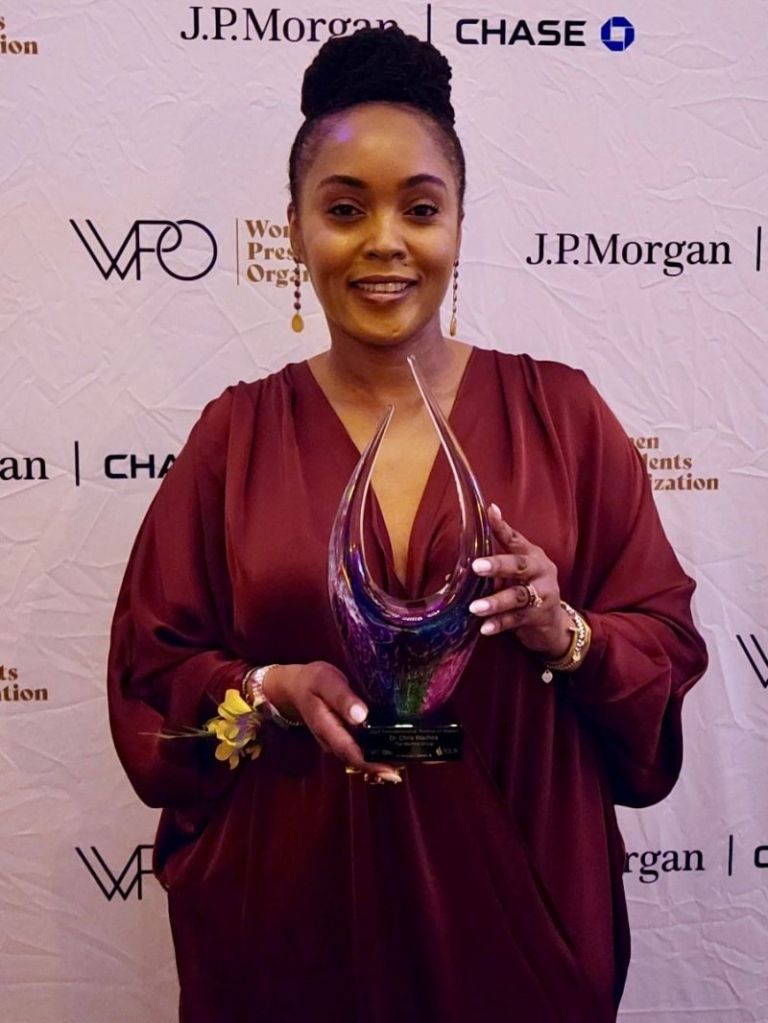
For much of my life, I have entered rooms where some part of me was the outsider.
A Kenyan building a life in America. A nurse moving into research and systems improvement. A healthcare leader becoming an entrepreneur. A scientist making wine. A winemaker entering distribution. And an African woman building businesses in industries where very few people looked or sounded like me.
For years, I thought success meant becoming exceptionally good at fitting into all of those rooms. I learned to observe quickly. Who has influence here? What matters to this group? What isn’t being said? How does this idea need to be communicated so people can actually hear it?
I became very good at adapting or shape shifting, if you will.
Looking back, however, I think I misunderstood where the real advantage was.
Perhaps the value wasn’t in learning how to fit into so many different worlds. It was in learning how to see across them.
The Rhino: Adaptability Requires Groundedness
The front label of our Wachira Cabernet Sauvignon features the African Rhino. The Rhino symbolizes strength, resilience, presence, and, for me, groundedness.
That last quality matters because while moving between cultures, professions, industries, and social environments requires adaptability, without a strong sense of self adaptability can gradually become conformity.
We often describe changing our communication or behavior across environments as code-switching. I increasingly think about the underlying capability as cultural intelligence: understanding the norms and dynamics of an environment well enough to navigate it effectively.
Spend enough time doing that, and another capability begins to emerge: cultural translation.
Learning to Speak More Than One System
Cultural translation isn’t limited to nationality, ethnicity, or spoken language. Every professional system develops a language of its own: healthcare has one, science has one, the boardroom has one, entrepreneurship has one, wine has one and the customer certainly has one.
I saw the consequences of those different languages repeatedly in healthcare: while a clinician saw a patient-care problem, the quality team saw process variation, an administrator saw capacity and resource constraints, and the executive saw organizational risk.
Same system. Different interpretations.
Someone has to connect them.
My career has repeatedly placed me at those intersections. Entrepreneurship expanded them further from scientific evidence to customer behavior, clinical outcomes to margins, production to distribution, and American business environments to African ones.
Over time, crossing those boundaries changed how I approached problems. I stopped seeing them exclusively through the lens of one profession or one industry. I started looking for patterns.
Why Outsiders Ask Different Questions
Improvement science gave me a methodology for examining systems: look for variation, constraints, assumptions, feedback loops, and unintended consequences. Being an outsider added another dimension.
Sometimes assumptions are easiest to recognize when they aren’t yours.
Inside established organizations, practices gradually become normalized.
That’s how we’ve always done it.
That’s just how this industry works.
Then someone unfamiliar with the history asks a deceptively simple question: Why?
Not because they necessarily know more. Sometimes precisely because they haven’t inherited all the assumptions that make the existing system seem inevitable. This is where outsider perspective can become organizational value.
Insiders bring institutional knowledge. Outsiders can bring fresh pattern recognition.
People who have learned to operate across multiple systems can sometimes bridge the two by understanding enough to participate while retaining enough distance to question.
When Organizations Hire Difference. Then Remove It
That has important implications for leadership. Organizations frequently say they want diverse perspectives. They recruit people from different cultures, disciplines, industries, and backgrounds because they expect those differences to produce better thinking. Then they introduce those people into cultures that reward them for learning how everyone else already thinks and behaves.
We hire difference. Then we socialize it out of people.
And later we wonder why diversity hasn’t produced different ideas! If leaders genuinely want the outsider advantage, inclusion cannot simply mean giving different people access to the existing system. It also means allowing their perspectives to challenge it. The person asking the uncomfortable question may not misunderstand your organization. They may be seeing something you’ve become too accustomed to notice.
But Adaptation Has a Boundary
There is a personal dimension to this that shouldn’t be ignored.
Learning to navigate different environments can be extraordinarily valuable. But there is a difference between adapting your communication to become more effective and changing yourself because you believe that’s the price of belonging.
I’ve experienced both!
One is strategic calibration. The other can become self-erasure.
It took me years to understand that distinction.
Authenticity doesn’t require behaving identically in every room. Leadership requires us to read audiences, understand context, and communicate accordingly. The question is whether you’re adjusting how you communicate who you are or gradually changing who you are allowed to be.
Cultural intelligence should expand your ability to navigate systems not require you to disappear inside them.
From Outsider to Systems Thinker
I used to struggle to explain a career spanning healthcare, neuroscience, improvement science, entrepreneurship, wine, distribution, Africa, and America. Today, I see less fragmentation and more integration because each world taught me something different.
Healthcare taught me to consider outcomes and human consequences.
Science taught me to question assumptions and look for evidence.
Improvement science taught me to examine the systems producing those outcomes.
Entrepreneurship taught me to make decisions with imperfect information.
Wine taught me the relationship between science, craft, patience, and judgment.
Cross-cultural experience taught me that the same problem can look remarkably different depending on where you’re standing.
Together, all these experiences developed a capability I didn’t have language for earlier in my career: the ability to stand inside a system while remembering what it looked like from the outside.
And that may be the real outsider advantage.
Put Your Outsider Advantage to Work
Perhaps your goal shouldn’t be to prove that you belong in every room you enter. Perhaps it’s to recognize what your journey allows you to contribute once you’re there. So, consider the environments you move between.
What can you see because you’ve worked in another industry?
What do you understand because you’ve lived in another culture?
What assumptions do you question because you weren’t taught to accept them?
Where are you translating between people who are technically discussing the same problem but speaking completely different professional languages?
And where might you be adapting so much that you’ve stopped bringing the very perspective that made you valuable in the first place?
Your difference becomes an advantage when you learn how to use it without surrendering it.
The Rhino reminds me to remain grounded while moving between worlds.
Learn the room. Translate when translation is needed. Question what others have stopped questioning.
But don’t confuse belonging with becoming indistinguishable. Because sometimes the perspective you developed standing outside the room is exactly what makes you valuable once you’re inside it.
This week, identify one perspective, experience, or part of your background that once made you feel like an outsider. Then ask yourself: How could I use that difference more intentionally in the rooms I’m in today?
I’d be interested to hear your answer: When has being the outsider helped you see something others couldn’t?