


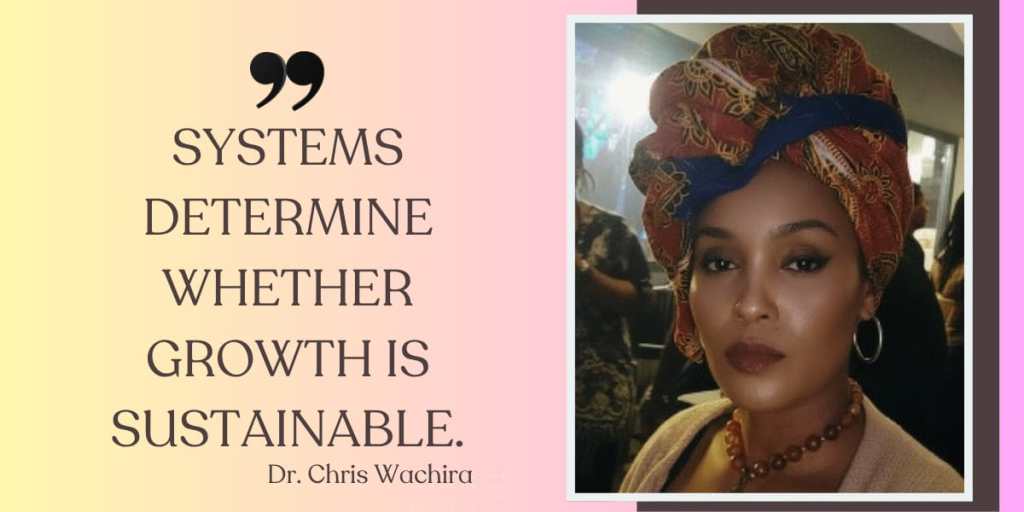
Early in my career, I believed success was primarily a function of strategy.
Think two steps ahead. Work harder. Get visible.
Then life served me a different lesson.
When I immigrated to the United States from Kenya, I arrived bearing ambition, determination, and an unwavering belief that good decisions naturally produce good outcomes.
What I discovered was more complex.
Outcomes are often shaped by forces operating beneath the surface; forces we rarely see until they begin limiting progress.
At first, I thought this lesson was personal. Over time, I realized it was universal.
Many leaders assume growth, performance, and transformation are primarily determined by talent, effort, and strategic vision. Yet some individuals, teams, and organizations consistently outperform others with seemingly similar capabilities.
The difference is often not strategy. It is the system.
That lesson deepened during my years in Neurosciences at Stanford, where I trained and worked in Improvement Science. My work centered on a deceptively simple question:
Why do systems produce the outcomes they produce?
The answer fundamentally changed how I think about leadership.
Performance is rarely determined by effort alone. Outcomes emerge from the interaction of people, processes, incentives, resources, leadership behaviors, and the environments in which they operate.
Years later, entrepreneurship would bring that lesson to life in ways no textbook ever could.
As a Kenyan immigrant building businesses in industries where very few people looked like me, I quickly learned that growth is not experienced equally.
Two founders can possess the same vision, discipline, and capabilities yet face vastly different paths to scale.
Some begin with access to capital, strategic networks, industry relationships, and institutional trust. Others must build all four while simultaneously building the business itself.
I built my plane while I was flying it! I experienced firsthand how invisible barriers shape outcomes: limited access to growth capital, fewer strategic introductions, higher burdens of proof, reduced margin for error, and the constant need to establish credibility before opportunities emerge.
These are not individual shortcomings. They are system conditions.
- What appears to be a market challenge is often a network challenge.
- What appears to be a leadership challenge may actually be a capital access challenge.
- What appears to be slow growth may be the result of structural constraints that were never acknowledged in the first place.
A Lesson From Wachira Wines
One of the most important lessons I learned while building Wachira Wines illustrates this perfectly. Like many entrepreneurs, there was a period when I became convinced our biggest challenge was sales. The logic seemed straightforward.
If revenue growth was slower than expected, then the answer must be better marketing, more sales calls, more promotions, and more visibility.
That is how most organizations approach growth challenges. They assume the problem sits at the point where the pain is felt.
In Improvement Science, we are taught to be skeptical of assumptions.
So instead of asking how to sell more wine, I asked a different question: What system is producing our current sales performance?
The answer surprised me.
The issue was not demand generation. The issue was distribution architecture.
As we examined the business more closely, we discovered that growth was being constrained by a series of interconnected factors:
- Limited access to distributor networks.
- Restricted retail placement opportunities.
- A lack of efficient pathways into larger accounts.
- Licensing constraints across state lines.
- Insufficient relationship density within the beverage ecosystem.
In other words, what appeared to be a sales problem was actually a market access problem.
Those are two very different diagnoses.
Had we continued treating it as a sales problem, we likely would have spent more money on marketing while producing only marginal gains.
Instead, we redesigned the system. We expanded our distribution capabilities!
- We strengthened strategic partnerships.
- We invested in building industry relationships.
- We developed import and distribution infrastructure through SOKO Distributors.
- We focused on creating access pathways rather than simply increasing promotional activity.
The result was not immediate magic. Systems rarely work that way.
But over time, the redesign removed constraints that strategy alone could never overcome.
The lesson was profound:
- You cannot market your way around a structural bottleneck.
- You cannot outwork a broken system indefinitely.
- And you cannot solve the wrong problem simply because it is the most visible one.
Why Leaders Misdiagnose Growth Problems
Most leaders are exceptionally skilled at solving visible problems. Few are trained to diagnose invisible ones.
- When growth slows, they revisit strategy.
- When execution falters, they reorganize teams.
- When transformation stalls, they launch new initiatives.
Yet many of these interventions fail because they address symptoms rather than causes.
As an Improvement Scientist, I start with a different question: What hidden system is producing this outcome?
The answer is often found in constraints that rarely appear on strategic plans:
- Decision bottlenecks.
- Leadership bandwidth limitations.
- Process variability.
- Dependency concentration.
- Incentive misalignment.
- Communication breakdowns.
- Resource allocation friction.
These factors rarely dominate boardroom discussions, yet they frequently determine whether strategy succeeds or fails.
One principle has remained true across every industry I have worked in: Organizations are perfectly designed to produce the results they currently achieve.
If outcomes are not improving, the solution is rarely more effort. It is a better diagnosis.
The leaders who learn to identify and remove invisible system constraints gain an advantage long before competitors recognize the problem exists.
Strategy determines direction.
Systems determine whether you arrive.
Questions Every Leader Should Ask
Before launching another initiative, ask yourself:
- Where does decision-making consistently slow down?
- What process creates the most friction for execution?
- Where are we dependent on a single point of failure?
- What assumptions about growth have we never challenged?
- Which outcomes are we treating as inevitable that are actually being produced by the system itself?
Because the greatest barrier to growth is often not what leaders can see.
It is what they have not yet learned to diagnose.
And the future belongs to leaders who can see the system behind the symptoms.